 Ballast

How to Secure a Gazebo So It Doesn't Blow Away
A canopy acts like a sail, so every gazebo needs holding down. Here is how to secure one on grass and on hard ground, and how much weight it takes.

The short answer
Secure a gazebo by weighting all four legs, and add pegs and guy ropes as well when the ground allows. On grass you can drive in pegs and run guy lines to the ground. On hard standing such as a car park, patio or event field you cannot peg down, so a weight on each leg is the only thing holding the frame. The larger the canopy and the more open the site, the more weight each leg needs.
Why gazebos blow away
A gazebo canopy acts like a sail. Even a light breeze pushing under the roof creates lift, and a sudden gust can throw an unweighted frame across a field in seconds. It is one of the most common causes of damage and injury at outdoor events, so securing the frame matters whatever the forecast says when you set up.
Four ways to secure a gazebo
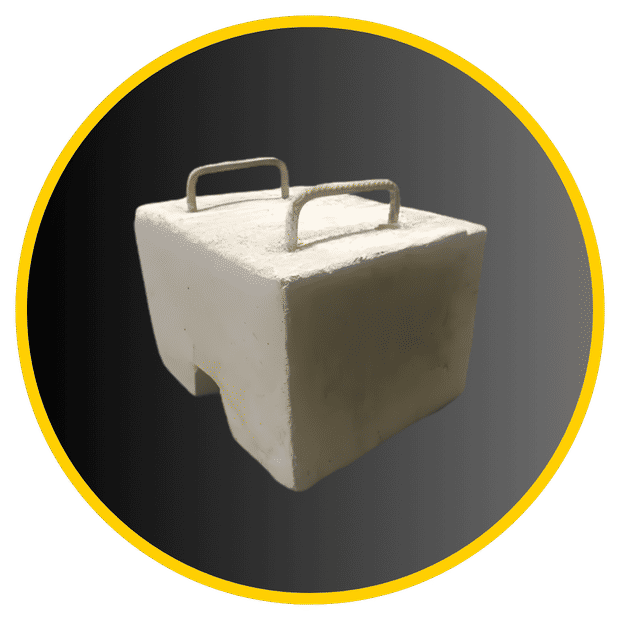
- Leg weights. A weight over each leg holds the frame down on any surface, and is the only workable option on hard ground. Concrete blocks give a fixed, known hold the moment they are placed.
- Ground pegs or stakes. Effective on grass and soft ground, driven through the foot plates. No use on tarmac or paving.
- Guy ropes. Lines from the roof corners down to pegs or weights add stability in wind, especially on taller frames.
- Tie to a fixed point. Where there is a wall, railing or vehicle alongside, securing the frame to it adds another anchor.
For most setups, weighting every leg is the core method, with pegs and guy ropes added on top where the ground allows.
On hard ground, weights are the only option
On a car park, forecourt, patio or sports hall floor there is nothing to peg into, so the whole job falls to weights. Water weights and sandbags get used, but they can leak, split or shift. A concrete ballast block gives a solid, fixed weight that stays put, and it lasts for years of reuse.
How much weight do you need?
As a starting point, allow one 40kg block per leg for a small gazebo on a sheltered site, and step up to heavier blocks or more per leg for larger frames or exposed ground. The right figure depends on the canopy size and how exposed the site is, so treat this as a starting point rather than a safety rating. Our guide on how much gazebo weights need to weigh goes into detail, and the marquee and gazebo weights page has the blocks themselves.
Common questions
What is the best way to secure a gazebo?
Weight all four legs, and add pegs and guy ropes as well when the ground allows. Weights work on any surface and are the only option on hard standing, so they are the core of securing any gazebo.
How do you secure a gazebo on concrete or a car park?
With weights. You cannot peg into hard ground, so a weight on each leg is what holds the frame. A concrete ballast block gives a fixed hold the moment it is placed and will not leak or shift like a water weight.
Do you still need weights if you peg the gazebo down?
On grass, pegs and guy ropes may be enough for a small frame in light wind, but adding weights gives a big margin of safety, especially as conditions change through the day. On hard ground, weights are essential because pegging is not possible.
Will weights stop a gazebo blowing away in strong wind?
The right amount of weight holds a gazebo steady in normal conditions, but no gazebo is safe in severe wind. In a storm or high gusts the safest step is to take the canopy down. Weighting every leg, not just one or two, gives the best protection the rest of the time.
Related guides
More on weighting event structures down:
Weighting a gazebo or marquee?
UK-cast concrete weights with a cast-in rebar handle, in sets to cover every leg. See the range and prices, or tell us the job for a delivered quote.
Ballast Blocks
UK-cast concrete ballast weights and kentledge for events, construction, fencing, marine and industrial anchoring. A Gala group brand. Visit Gala Tent.