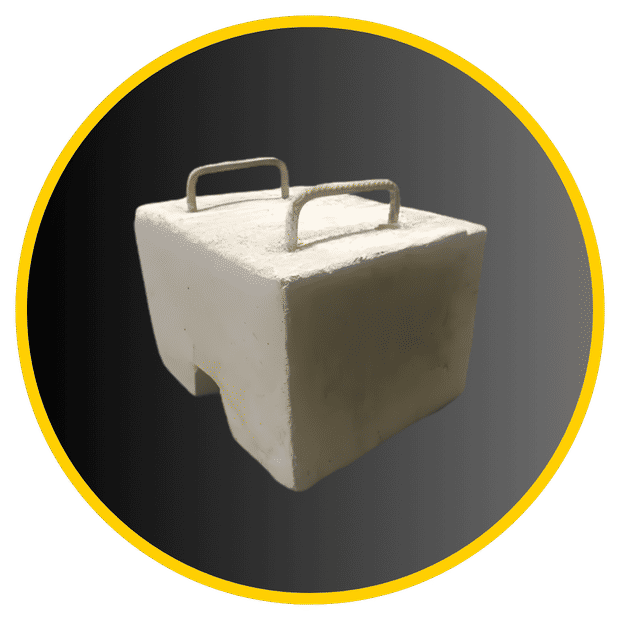
 Ballast
What Is Kentledge, and How Much Do You Need?
Kentledge is dead weight used as a counterbalance or hold-down. Here is what it is, what it is used for, and how the amount is worked out.
The short answer
Kentledge is dead weight, usually concrete or iron, placed to resist an upward or sideways force. It counterbalances cranes and rigs, holds down tanks and temporary works, and provides the reaction weight for load testing. How much you need depends entirely on the force being resisted, so for load-critical jobs the figure comes from an engineer, not a rule of thumb. Precast concrete blocks are the everyday form: cast to a known weight, stackable, and reusable across jobs.
What kentledge is
The word simply means ballast used as a counterweight. Historically it was pig iron in a ship's hold; on site today it is most often precast concrete blocks. Concrete wins for most work because it gives a known weight at a fraction of the cost of cast iron, stacks to build up the mass you need, and lasts for years outdoors.
What kentledge is used for
- Counterweight for cranes, rigs, hoists and davits.
- Reaction weight for pile and anchor load testing.
- Ballast for scaffold, mobile access towers and temporary works.
- Hold-down for tanks, pipework, ducting and buoyant structures.
- Frame ballast for solar arrays, temporary buildings and signage gantries.
How much kentledge do you need?
There is no rule of thumb, because it depends on the exact force you are resisting and the safety factor the job demands. For load-critical and structural work, such as pile testing or crane counterweight, the required mass is calculated by an engineer, usually with a margin above the working load. We supply blocks to the figure you specify and can build up the tonnage by stacking, but we do not provide the engineering calculation itself. Confirm the mass and any certification with your engineer, then tell us the tonnage.
Which blocks to use
100kg and 500kg blocks stack to build up the mass a job needs, and a 1000kg single block gives a full tonne in one lift. See the industrial kentledge page, or the full products range for every size and price.
Common questions
What is kentledge?
Kentledge is dead weight used as a counterbalance or hold-down: a dense mass, usually concrete or iron, placed to resist an upward or lateral force. Precast concrete blocks are the common form, cast to a known weight and reused across jobs.
What is kentledge used for?
Counterweight for cranes and rigs, reaction weight for pile and anchor load testing, ballast for scaffold and temporary works, and hold-down for tanks, pipework and buoyant or wind-loaded structures.
How much kentledge do I need?
It depends on the force being resisted and the safety margin required, so there is no single figure. For load-critical and structural jobs the mass is calculated by an engineer. Once you have the tonnage, we can supply and stack blocks to reach it.
Do you provide engineering calculations for kentledge?
No. We supply blocks to a known weight and to the tonnage you specify, but the engineering calculation and any sign-off for load-critical work is done by your engineer. Give us the figure and we will supply the mass to match.
Is concrete or cast-iron kentledge better?
Concrete suits most site and yard work: it gives a known weight, stacks to build up mass, and costs far less than cast iron. Cast iron is compact and precise but expensive, and is rarely justified outside specialist rigs where space is tight.
Buying kentledge by the pallet?
UK-cast concrete kentledge in 100kg, 500kg and 1000kg blocks, stackable to any tonnage, delivered UK-wide. Tell us the mass you need for a quote.
Ballast Blocks
UK-cast concrete ballast weights and kentledge for events, construction, fencing, marine and industrial anchoring. A Gala group brand. Visit Gala Tent.