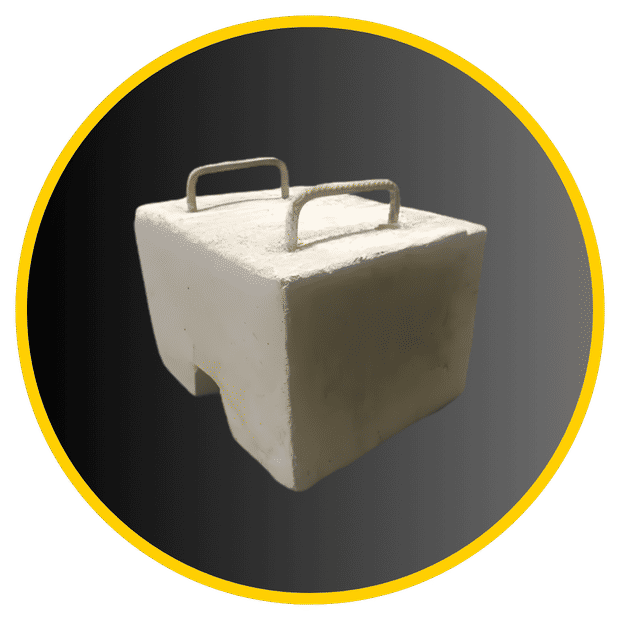
 Ballast
Will Concrete Weights Damage My Surface?
Using weights on decking, paving, forecourts and sports floors, and how to protect a finished surface.
The short answer
On rough, hard-wearing ground such as tarmac, grass, hardcore or a working yard, no. A concrete block sits flat and spreads its load, so it does not dig in. On a finished or decorative surface, such as smart block paving, timber decking, a resin drive, a shop forecourt or a sports hall floor, pop a mat or board under each block to avoid scuffs or marks. The blocks have a broad, flat base, so with a little care they hold structures down without harming what they sit on.
Why the base matters
Damage from a weight usually comes from a small, sharp contact point concentrating the load, or from dragging it across a surface. A ballast block avoids both: it presents a broad flat underside that spreads the weight over a wide area, and it is meant to be lifted and placed, not dragged. That is why the same block that would be fine on a car park is also fine on paving, as long as it is set down gently.
Surface by surface
- Tarmac, hardcore, grass, yards. No protection needed. Set the block down and go.
- Block paving and slabs. Generally fine, but a mat or board under each block avoids any risk of scuffing or rocking on an uneven joint.
- Timber decking. Use a board or mat to spread the load across the boards and protect the finish.
- Resin, epoxy and painted floors. Always use a mat, as these finishes mark easily under point pressure or grit.
- Shop forecourts and showrooms. A mat keeps a smart surface pristine and stops grit under the block scratching it.
- Sports and hall floors. Protect with a board or mat, and never drag the block.
Simple ways to protect a finish
- Lift, do not drag. Dragging is what scratches a surface, so carry or machine-place the block.
- Use a mat or board. A rubber mat, carpet tile or offcut of ply under each block spreads the load and takes any grit.
- Brush the spot first. Clearing grit from under where the block will sit avoids trapped stones marking the surface.
See the full range and prices, or read how to store and reuse your weights.
Common questions
Will concrete weights mark my forecourt or paving?
They spread their load on a broad flat base, so on most paving they are fine. On a smart or decorative finish, a mat or board under each block removes any risk of scuffing, and clearing grit from the spot first helps too.
Can I use concrete weights on decking?
Yes, with a board or mat under each block to spread the load across the deck boards and protect the finish. Lift the block into place rather than dragging it.
Do they damage grass?
For short periods, no. A block left on grass for a long event may flatten or yellow the patch underneath, as anything heavy would, but it recovers. There is no lasting damage to the ground.
How do I protect a finished floor indoors?
Use a mat or board under every block, keep the area clear of grit, and never drag the weight. That keeps a sports hall, showroom or resin floor mark-free while still holding your structure down.
Weights that hold, without the worry
UK-cast concrete weights with a broad, flat base, in sets and full pallets, delivered UK-wide. See the range and prices.
Ballast Blocks
UK-cast concrete ballast weights and kentledge for events, construction, fencing, marine and industrial anchoring. A Gala group brand. Visit Gala Tent.