 Ballast

How to Stop a Sign or A-Frame Blowing Over
Freestanding signs and barriers are sails on legs. Here is how to weight them so they stay upright on forecourts, pavements and open ground.
The short answer
Weight the base of the sign. A-frames, forecourt boards, pavement signs and barriers stand on the surface with nothing fixing them down, so a gust tips them over. A weight on the base, or over the foot, holds the sign level and steady. The bigger the board and the more open the spot, the more weight it needs, and a tall sign needs more than a low one because it catches wind higher up.
Why signs blow over
A sign is a flat face pointed at the weather, and most stand freely with a low, light base. Wind pushes on the board and levers it over at the foot. It is not just a nuisance: a sign blown into a road, a car or a passer-by is a real hazard, so anything left out needs holding down properly rather than trusting its own weight.
How to weight a sign or barrier
- Weight the base. Sit a block on the sign's base tray or over its foot so the weight sits low, where it does the most to stop the sign levering over.
- Both feet on barriers. For crowd-control and pedestrian barriers, weight each foot, not just one end of the run.
- More for tall or large boards. Taller signs and bigger faces catch more wind, so step up the weight or add a second block.
- Do not trust the sign's own weight. Most A-frames and boards are far too light to stay put in wind on their own. The weight is what holds them.
Which weight to use
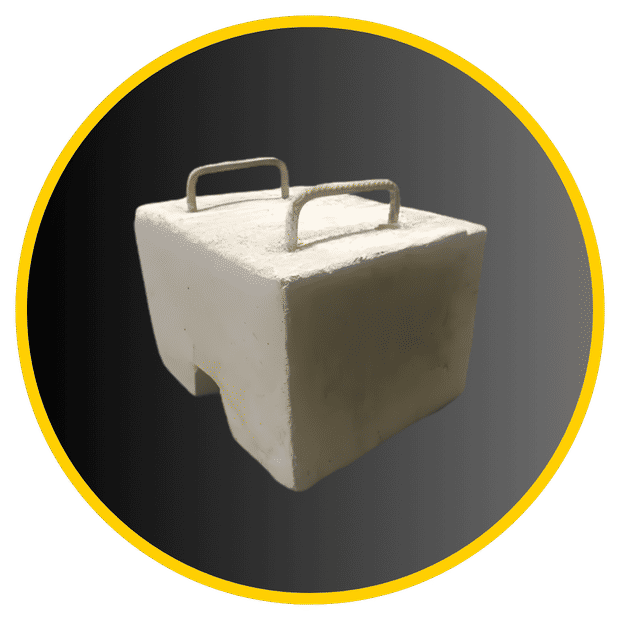
A 40kg block suits most A-frames, forecourt boards and barrier feet, carried by hand on its cast-in rebar handle and set straight on the base. For tall signs or exposed sites, step up to a heavier block or use more than one. On a finished surface such as smart paving or a shop forecourt, pop a mat or board under the block to avoid marking. See the signage and barrier weights page, or the full products range for every size and price.
Common questions
How do you stop an A-frame sign blowing over?
Sit a weight on its base. An A-frame is light and freestanding, so wind levers it over at the foot. A block on the base tray holds it down and keeps it upright. Step up the weight for larger boards or exposed spots.
How much weight does a pavement or forecourt sign need?
A 40kg block holds most standard A-frames and boards. Tall signs, large faces and open, windy sites need more, so use a heavier block or a second one. If in doubt, weight it heavier rather than risk it going over.
Can you weight down crowd barriers and traffic boards?
Yes. The same blocks weight the feet of crowd-control and pedestrian barriers and steady traffic-management boards, so they stay put on hard standing where you cannot fix into the ground. Weight each foot along the run.
Will the weights mark a forecourt or pavement?
They sit on a broad flat base, so they spread their load rather than digging in. On a finished or decorative surface, a mat or board under the block avoids marking, as with any heavy weight.
Weights for signs and barriers
UK-cast concrete weights for A-frames, forecourt boards and barriers, in sets and full pallets, delivered UK-wide. See the range and prices, or tell us the job for a quote.
Ballast Blocks
UK-cast concrete ballast weights and kentledge for events, construction, fencing, marine and industrial anchoring. A Gala group brand. Visit Gala Tent.